It is seen.
There is form, image, music and finish.
Leonardo Estrada Studio · Dramaturgy applied to communication, marketing and video.
We translate the real value of your brand into communication that can be understood, felt and chosen.
Ideas with structure. Stories with intention.
Move the cursor: from shadow to meaning.
We read what has not yet been said, identify what is not working and build the form that is missing so a brand’s value can become visible.
Perceive what is not being said. Understand what is not working. Build what is missing.
A piece can have camera work, light, music, editing and rhythm — and still fail to build a reason to watch, remember or act. Aesthetics attract attention. Structure decides what happens to that attention next.
We are not looking to add more. We are looking to discover what the piece needs for its value to stop being hidden.
There is form, image, music and finish.
The audience recognises what is at stake and why it matters.
The message connects value to a need and opens a path to action.
SOLUTIONS WITH A FUNCTION
I do not start from a task list. I start from the problem: what the audience needs to understand, what they need to feel, what decision we want to make easier and what language can make that visible.
Scripts, dramaturgical review, narrative editing and videos for brands, creators or personal stories.
VIEW SAMPLEBefore and afterCopywriting, scripts, SEO content and campaigns to communicate a brand’s value and connect with its audience.
VIEW SAMPLESEO writingCommunity management, message handling, sales support, email and basic customer organisation.
VIEW SAMPLECustomer care and follow-upClasses and workshops in AI, communication, marketing, writing, storytelling and art applied to real projects.
VIEW SAMPLEApplied learning
One visual logic across different disciplines. As in a staging, nothing is there merely to decorate: every sign helps construct meaning, reveals the discourse and makes the purpose of the piece visible.
You do not need to talk about dramaturgy. You need something to happen: a brand to be understood, a story to move someone, or a skill to become practice. That is where we start.
For businesses, brands, creators and agencies. When your content exists but does not explain why it matters: strategy, audit, scriptwriting, video, copy and campaigns.
From “this is what I do” to “this is why you should choose me”.
For people with memories, anniversaries, tributes or journeys. Separate photos and videos that can find a concept, a progression and an emotion of their own.
From an archive of memories to a piece that says something about you.
For professionals, learners and teams. 1:1 sessions and workshops in AI, communication, marketing, writing, dramaturgy and audiovisual creation applied to your project.
From knowing a tool to knowing what to build with it.
DRAMATURGICAL VIDEO AUDIT
For reels, ads, brand videos or personal pieces that “look good” but do not quite work. I do more than a marketing review: I combine strategy, communication and dramaturgy to understand what the piece is telling, how it progresses, what the person on screen communicates and what function each audiovisual decision serves.
The professional review brings together objective, audience, structure and audiovisual language. The diagnosis becomes reasoned observations and priorities for change.
Reading.
Judgement.
Decisions.
What is the piece communicating?
Where does the intention get lost?
What should change first?
1 video up to 90 seconds.
For pieces that need more than diagnosis.
When the problem does not live in a single video.
Marketing helps read audience, need, value proposition and action. Dramaturgy adds another layer: structure, progression, staging, behaviour, rhythm, credibility and the relationship between words, image and sound.
Audience and context · need or friction · product function · value proposition · message · CTA.
Scene order · progression · focus · tension · rhythm · gaze · gesture · presence · credibility of the action.
Relationship between text, body, framing, image, music, voice, silence, time and the meaning of each element.
The viewer does not need to know how to name what is wrong to feel unconvinced and keep scrolling. My job is to identify those frictions and turn them into concrete decisions.
Send me the link and your objective. If I do not believe the audit will bring you enough value, I will tell you before charging you.
I do not review only the hook, CTA or value proposition. I combine marketing, communication and dramaturgy to analyse how the video is built: scene order and progression, rhythm, gaze, gesture, on-camera presence, credibility, and the relationship between words, image, music, silence and meaning. The aim is not only to detect what fails, but why a viewer may stop believing, feeling or watching.
A personalised video diagnosis of one piece up to 90 seconds, a technical review document with findings and recommendations, and an actionable summary of priorities for change. We review audience/context, central idea, progression, rhythm, image, performance or on-camera presence, voice, music, text and CTA.
Not in the €59 audit. That option diagnoses the piece and tells you what to change, why and in what order. If you want me to implement the changes and deliver a new version, I can quote separately based on the material and scope.
Yes. If, after reviewing the material, it makes sense for me to handle the implementation myself, I can prepare a combined proposal at a better price than booking both phases separately. The quote depends on the actual editing and production work involved.
No. The audit improves the video’s clarity, structure, intention and creative execution, but commercial results also depend on the product, offer, price, distribution, targeting, landing page, investment and other factors beyond the piece itself.
An accessible link to the video and a brief explanation of what you want to achieve and what you think is not working. I first check whether I can genuinely add value, and only then do we discuss payment.
A 12-question dramaturgical checklist to detect whether the problem lies in the audience, need, product function, progression, rhythm, timing or CTA.
Diagnosis · self-assessment questions · result scale · Café Nexo mini-case · time and recurrence · next step.
It is free in exchange for your name and email. Marketing communications are optional and have their own checkbox.
METHOD · REVEAL AND RESOLVE
Dramaturgy gives me a method for looking before producing: perceive, understand, build and reveal. The final move is not to “make it prettier”, but to make visible what truly matters.
I read what has not yet been said: the need, tension, desire, context and what the piece is trying to communicate without having fully formulated it.
I identify what is not working and why: where clarity breaks, what is unnecessary, what is missing and what is competing for attention.
I organise information, image, word, body, rhythm and time so every element has a function within a progression.
I turn that structure into a clear, sensitive and actionable message: something that can be understood, felt and chosen.
Hide just enough to provoke. Reveal what is needed to understand. Illuminate what is decisive for action.
Adjectives decorate. Value appears when a feature fulfils a function within a situation. It is not enough to say a phone has more RAM, a better screen or a better camera: those features must connect with a real need, an action and a specific person.
The same is true in a work of art. A set stops being mere background when it strengthens the character, the situation and the meaning of what happens.
Cases and demonstrations
Real work and clearly identified demonstration exercises coexist here. The aim is to show process, judgement and what changes when a piece is structured around a real need.
Some stories are not told through dates, but through moments.
The starting point was simple: tell a love story with photographs. The structure emerged when everything began to revolve around a date, memory and the idea of having reached the present together.
A black-and-white flower opens the memory; then image, voice, music, editing and subtitles connect through visual and emotional associations. Boats lead to other images with boats, roads accompany the idea of searching the world, and an embrace coincides with the idea of finding one another. Every element tries to belong to the same structure.
The piece condenses an entire life into a short format: childhood rejection, a romantic encounter, relationship, family, work, the passage of time and a visual ending that reunites the two characters as halves of the same heart.
There is no dialogue. The story is built through action, character design, colour, space, editing and emotional progression. Each character is defined by what they do, and every scene has to move the protagonist’s life forward with maximum economy.
AI supported the development of the concept, visual design and animation. The conceptual direction, script, dramatic structure and treatment of the story were developed by Leonardo.
Imagine a café launches this ad and does not get the response it is looking for. It hires us to understand what is wrong and rethink the piece. Here we show a small part of that work.
Working hypothesis: the ad shows calm and coffee, but the person, usage occasion and reason to choose the brand remain vague. The intervention connects those elements to a specific need.
Fictional, illustrative scenario. It does not represent a real engagement or measured conversion results.
In this scenario, the brand publishes an appealing piece but fails to communicate a specific reason to choose it.
We review audience, situation, product function and progression. We rebuild the structure around a real task.
The new message connects person, coffee, space and need: a place to finish what matters.
Before the intervention.
Vague buyer persona · generic value proposition · passive product · unclear usage occasion · interchangeable message.
After applying the diagnosis.
Defined person · usage context · friction · functional benefit · reason to return · specific promise.
If we replaced the cup with tea or a glass of wine, the first scene would still tell almost the same story. The campaign sells calm, but not a specific reason to choose Café Nexo.
Ana needs to keep working and finish something important. The coffee, power outlet, calm and space become an answer to a specific situation. The value proposition stops being decorative.
“Your favourite place” could belong to almost any café. “Your place to finish what matters” connects product, usage occasion and need in a single campaign idea.
Now it is clear what Leonardo Estrada Studio can do: identify where the message gets lost, explain why and build a clearer direction. Re-editing or production is quoted according to scope; it is not included in the basic audit.
I want to review my videoThis example simplifies some findings to make the transformation visible. A professional audit goes deeper into the objective, audience, context, scenes, progression, rhythm, on-camera presence and relationships between text, image and sound. We deliver the technical review document, video diagnosis and priority summary; restructuring or implementation depends on the service commissioned.
The before/after shows a change in narrative approach. Commercial response also requires evaluating the offer, distribution and other factors: no sales or conversion improvements are claimed here.
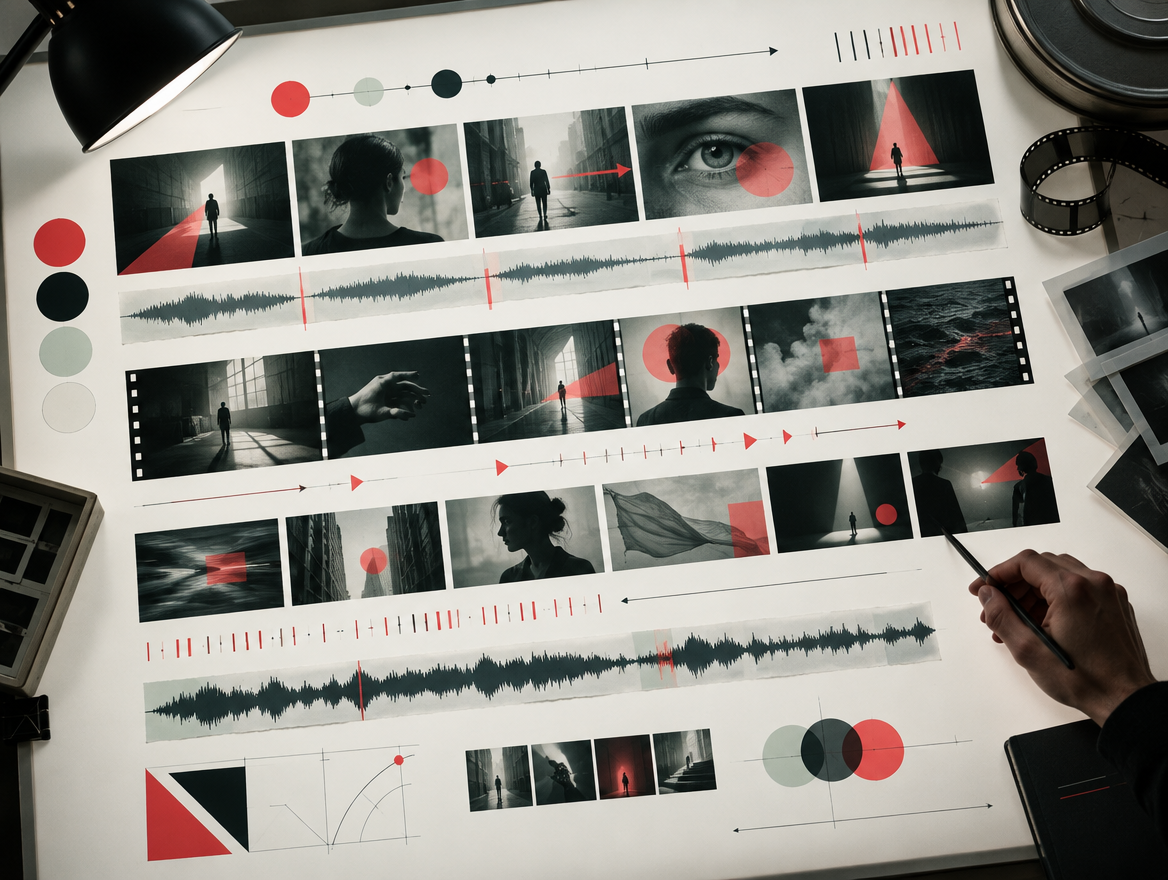
Colour, framing, music, repetition and silence also write. Analysing them helps us understand what a piece communicates before touching the edit.
ABOUT ME · THE ORIGIN OF THE STUDIO
Before I studied marketing, I learned to tell stories and observe people.
In Cuba I studied Dramaturgy at the University of the Arts. But my education did not happen only inside a classroom.
I wrote, taught, worked with students, practised cultural journalism and criticism, took part in creative projects and spent years trying to understand why a story works: what a person wants, what stops them, what changes a situation and what makes someone want to keep watching.
I wanted to build something of my own.
I imagined and designed different projects with the intention of starting something of my own. Some went further than others. But circumstances, the limitations of the context and life itself gradually pushed that idea further away.
I came to complete a postgraduate programme in Marketing and Digital Communication at ESIC Valencia.
And when you start again in another country, you do not always begin by working in the field you trained for. You work where you can, learn, adapt and keep moving. Hospitality was part of that journey. Then came different business environments, customer service, sales, commercial consulting and marketing.
I worked for others until I understood what I wanted to build for myself.
While studying Marketing and Digital Communication and applying what I learned in Spanish companies, I began to understand more clearly how a value proposition is built, how a brand is positioned, how audiences are studied, how content is designed for different objectives and how a brand tries to find a distinctive place among many others.
Commercial work added another layer: it allowed me to observe those strategies when they reached direct contact with people. How they ask, hesitate, compare, postpone, trust and finally decide.
But an idea I had left behind also returned. I was working, producing, learning and contributing my knowledge to other people’s projects; increasingly, I felt that all that experience could also become something I built from the ground up.
So I began experimenting on my own work: with my content, my social channels, writing, video, digital tools and artificial intelligence. I tested an idea, watched what happened, changed a structure, edited again and started over.
Another marketing technique was not always what was missing.
That is where I recognised something that had been with me for years. Sometimes structure was missing. Tension was missing. Rhythm was missing. Understanding the desire of the person on the other side was missing. What was missing was knowing what to reveal, when to reveal it and what needed to happen next.
It taught me to work with actions, desires, conflicts, rhythm, time, transformation and meaning.
It taught me to connect a proposition with a market, an audience, a need and a distinctive position.
They allowed me to observe what happens when that proposition enters a real conversation.
It taught me that knowing something is not enough if we do not know how to use it.
They taught me to research, interpret and find a precise way to tell.
It gave me new tools to turn everything above into execution.
Not as a break with what I had done before, but as the place where everything that came before could finally meet.
Today I use that combination to work on one question that runs through almost everything we do at the Studio:
What is preventing the value that already exists from being understood, felt and chosen?
Sometimes the answer is in a story. Other times it is in the structure of a website, a sales conversation, a campaign, a video or training that transmits knowledge but still fails to turn it into applied learning.
My work begins by finding that point.
And building what is missing.
Dramaturgy works with the layers of a work: it relates them, structures them and gives them form so they can build meaning. Those layers may be verbal, visual, musical, physical, spatial or temporal.
It is not only about telling a story. It is about understanding what each sign does, how it interacts with the others and what experience the whole creates.
Light · line · colour · symmetry · composition · space
Rhythm · agógica · tono · melodía · instrumentación · carácter
Gesture · posture · objective · conflict · desire · action
Information · progression · tension · suggestion · turn · closure
Audience · need · pain point · desire · message · action
Selects, organises and shapes signs according to an intention.
Turns those decisions into a language of its own.
Interprets, completes, imagines and enters into dialogue with it.
When I studied marketing, I recognised connections with tools I already knew from dramaturgy. They are not the same, but they speak to one another: both disciplines try to understand a person, their motivations, conflicts and what can move them to act.
That is why a campaign, reel or advertising piece can also be worked on dramaturgically: who speaks, to whom, what they want to provoke, what information they reveal, what emotion they build and what action they expect next.
Storytelling is one part. Dramaturgy also looks at the relationship between image, body, word, music, space, rhythm, time and audience.
This excerpt sums up an idea that runs through the way I work: a product does not exist in isolation. It lives within a person, a context, a need and a meaning.
The products we sell are sold to someone, and those products live within an emotional space for that customer.
I use a shower curtain as an example because it forces us out of the feature catalogue. The question stops being only “what am I selling?” and becomes “what does this mean within that person’s experience?”.
If that bathroom functions as a space for calm, privacy or recovery, communication can begin to build value around that situation. We are not inventing a need: we are understanding more precisely the context in which the product already participates.
Characterisation matters here too: the better we understand the person and their situation, the better we can decide which product attribute is substantive and which is merely decorative.
In dramaturgy, a deadline can make an action urgent. In marketing, time can change a decision, a relationship and even the way a brand remains in memory.
How can we bring time into the content we create? Think, for example, of The Odyssey.
The deadline increases pressure on the objective and makes every obstacle carry more weight.
A real limit can focus a decision. Urgency works when it genuinely exists, not when it is artificially manufactured.
Deadlines, launches, pre-sales, registration closings and real windows that turn an intention into a concrete decision.
Discovery, consideration, purchase, experience, repetition and recommendation: a commercial relationship also has temporal structure.
Anticipation, waiting, repetition, memory and reward change how long a brand remains in the mind, even when the clock measures the same time.
Understanding when a need reappears helps design usage occasions, habits and reasons to return.
Marketing does not only create value for a person. It also organises when that value appears, how long it lasts and what remains afterwards.
That is why Café Nexo can also be read through time: if someone returns when they need concentration, calm or to finish a task, we are no longer talking only about a cup. We are talking about a usage occasion that can repeat.
Bring an idea.
Learn how to shape it.
I can also work with you as a teacher. Individual sessions and workshops are designed around a specific need, not a generic syllabus.
We start from your level and what you want to build: a script, a campaign, an article, a book or a text that needs a new reading. You bring the objective; together we shape the session.
Tell me what you want to learnThe lesson starts from a simple idea: describing a character generically is not the same as introducing a detail that makes them distinctive. Shape, texture, colour, scar, posture or clothing can begin to reveal who they are, how we perceive them and what world they inhabit.
The same principle also works in marketing. A buyer persona does not become valuable by accumulating curious traits, but when some of those details change a need, behaviour, friction or decision. That is when characterisation stops being decorative and begins to guide product, message and experience.
In dramaturgy: “Ana is a fair-skinned woman” barely begins to draw her. If we add a distinctive visual trait — for example, moles in an unusual pattern — her image becomes more recognisable. But characterisation does not end there: we need to know what she does, wants, avoids and what situation she is going through.
In marketing: not all those details have commercial value. Now imagine Ana creates content on her phone while working away from home, often records at night, edits before publishing and does not want to depend on a power bank. Then battery life, low-light camera, stabilisation or AI editing stop being mere features: they respond to concrete situations in her life.
Person + context + need + friction.
A product, service or experience with a real function.
Turn features into relevant benefits and a message that person can recognise as their own.
What can we work on from here? Useful buyer personas, segmentation, value proposition, scriptwriting, storytelling, copy, audiovisual content and use of AI to research, prototype ideas and produce variants with judgement.
Characterisation is not about accumulating details. It is about discovering which ones change the relationship between a person, a situation and a need. When that reading is strong, the chances of designing something people consider genuinely useful and want to buy increase.
I want a session or workshop →How do you create characters that truly hook people?
Spanish · English · French
It might be selling an idea better, building a video, turning memories into a story, improving your content or learning a tool. Tell me the objective before the solution.
Seville, Spain. Remote work.